
Portfolio
Late-stage companies that went on to define their categories.
Early positions in companies that went on to define their categories. Shown as text, for identification only.
Sources
Portfolio · Cerebras
Wafer-scale compute. Cerebras builds the processor the size of the wafer.
Most AI chips are cut from a wafer; Cerebras keeps the whole wafer as one processor.
Cerebras: one wafer, not one chip
- Cerebras WSE-3 Turbo
- 46,225 mm²
- NVIDIA H100 die
- 814 mm²
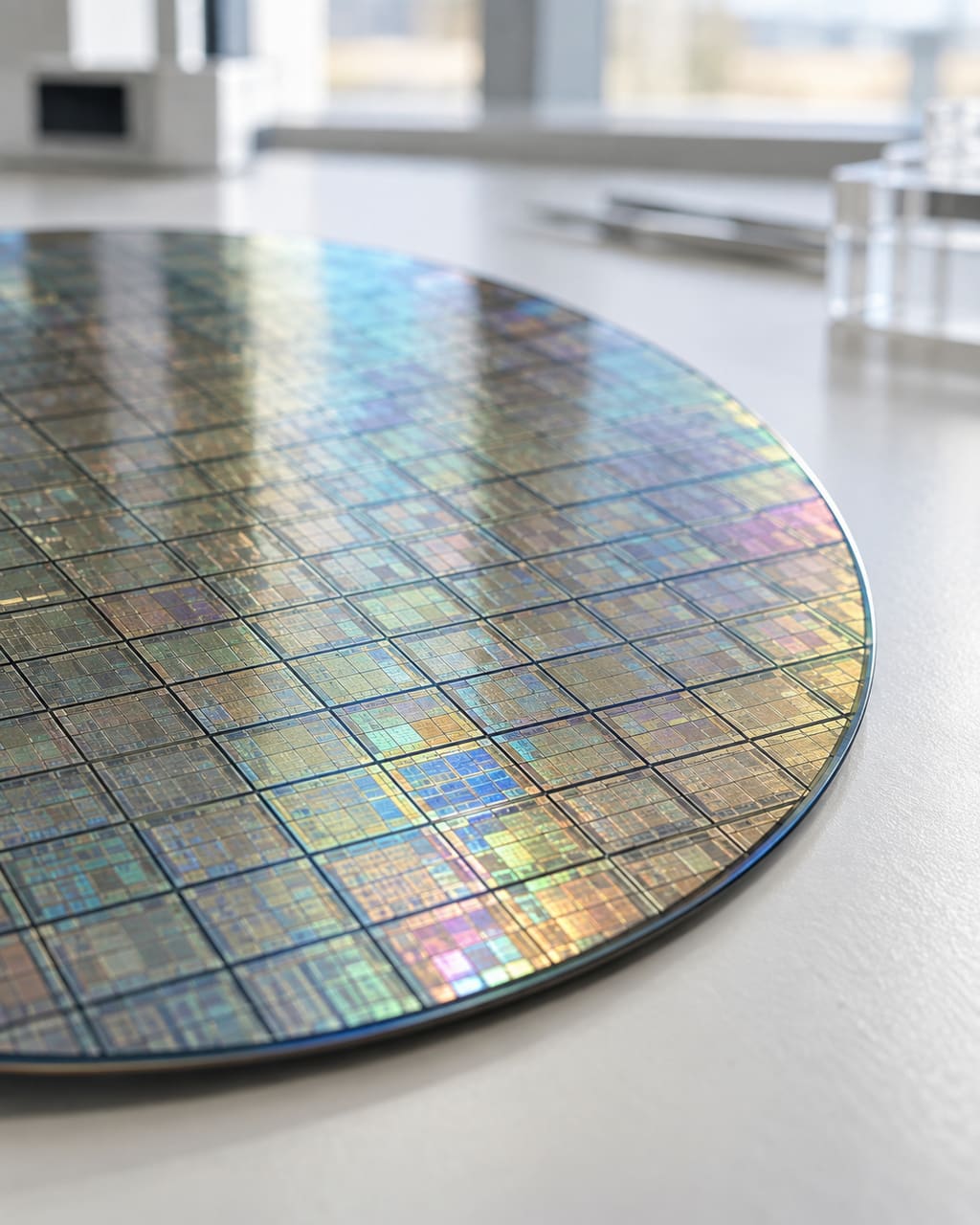
The wafer is about 57 times the area of a leading GPU die, drawn here to true relative scale.
Keeping a model's working data on one wafer avoids shuttling it between chips; Cerebras says its systems run inference up to 30 times faster than GPU systems. For buyers, that is cost and speed per token.
Illustrative geometry, sourced figures.
Portfolio · Stripe
Payments at national scale. Stripe moves more money than many economies.
Stripe's 2025 total volume, ranked against national GDP on one shared scale.
If Stripe's 2025 volume were an economy
- Stripe volume$1.9T
- Canada$2.3T
- Spain$1.9T
- Australia$1.8T
- Mexico$1.8T
- Indonesia$1.4T
- Netherlands$1.3T
- Saudi Arabia$1.3T
- Stripe volume, 2025
- 1.9 trillion dollars of total volume in 2025

Equivalent to roughly 1.6% of global GDP, per Stripe.
Payments infrastructure compounds with the economy it serves, and agents will soon be paying for things too.
Nominal GDP, IMF WEO April 2026; Stripe total payment volume 2025, per Stripe. Volume processed is not revenue.
Illustrative geometry, sourced figures.
Portfolio · Perplexity
Search, rebuilt. Perplexity turns search into answers.
The same question asked two ways, and who does the reading and assembling in each.
Perplexity: an answer engine, not a list of links
Search today · you do the work
Perplexity · it does the work for you

- Search today · you do the work: Your question; Ten links to open; You read and compare; You write the answer.
- Perplexity · it does the work for you: Your question; It reads the pages; One cited answer; Pages it cites.
The work of reading and assembling moves from the person to the product. That is a different business from selling clicks.
Illustrative geometry, sourced figures.
Sources
In brief
What it does, who buys it, why it compounds
Three more holdings, each described in three short lines.
AuditBoard
- What it does
- A connected platform for audit, risk and compliance teams.
- Who buys it
- Internal audit, risk and compliance leaders.
- Why it compounds
- Once a company's controls live in one system of record, every new regulation adds work to that system.
More than 2,000 enterprises, including nearly 50% of the Fortune 500, at the time of the Hg agreement.
Salsify
- What it does
- Product experience management: the product content brands publish to retailers and marketplaces.
- Who buys it
- Consumer brands and manufacturers.
- Why it compounds
- Every new retailer and marketplace multiplies the content a brand must keep correct.
More than 2,000 customers, including many leading consumer brands, per Cinven.
Neo4j
- What it does
- The graph database: data stored as connected entities rather than tables.
- Who buys it
- Engineering and data teams in large enterprises.
- Why it compounds
- Agents and retrieval work better on connected data, which puts graphs under more AI applications.
Used by 84% of Fortune 100 companies, per Neo4j.
Holdings
Held, realized and exited. Every holding, grouped by status.
Held first, then partially realized, announced, exited or restructured, shown by name and area.
Neo4j
HeldThe graph database.

Qumulo
HeldHybrid cloud file data storage.

SambaNova
HeldEnterprise AI systems.

DataRobot
HeldEnterprise machine learning.

ThoughtSpot
HeldAI-powered analytics.

Course Hero
HeldStudy resources for students.

Perplexity
HeldAn answer engine for the open web.
See the explainer ↓Verbit.ai
HeldAI transcription and captioning.

Aviatrix
HeldCloud network security.
BigID
HeldData security, privacy and AI governance.

Tanium
HeldAutonomous endpoint management.
Attentive
HeldAI marketing across SMS and email.
Rappi
HeldOn-demand delivery across Latin America.

Stripe
HeldFinancial infrastructure for the internet.
See the explainer ↓
Tealium
HeldReal-time customer data platform.
Flexport
HeldTechnology for global supply chains.

Stord
HeldCommerce fulfillment and logistics.

Tradeshift
HeldE-invoicing and procurement.

Invoca
HeldConversation intelligence for revenue teams.

Outreach
HeldAI sales execution platform.
Podium
HeldAI for local businesses.

AngelList
HeldSoftware for startups and venture funds.
CityBlock Health
HeldValue-based care for underserved communities.
Response Pharmaceuticals
HeldWeight management for high-need patients.

Cerebras
Partially realizedIPO, May 2026.
See the explainer ↓
Scale AI
Partially realizedMeta's 2025 investment in Scale AI.

Salsify
AnnouncedAgreed to be acquired by Cinven, 2026 (pending).

DataStax
ExitedAcquired by IBM, 2025.

Reltio
ExitedAcquired by SAP, 2026.

SingleStore
ExitedGrowth buyout led by Vector Capital, 2025.
AuditBoard
ExitedAcquired by Hg, 2024.

Thrasio
RestructuredChapter 11 restructuring, 2024.
Company names and logos are trademarks of their respective owners and are shown to identify holdings. No endorsement is implied.
Sources
- 1. CNBC, May 13, 2026: Cerebras prices IPO above expected range.
- 29. Bloomberg, June 13, 2025: Meta finalizes $14.3 billion Scale investment, hires its CEO.
- 11. Salsify, July 22, 2026: Cinven to acquire Salsify, Inc. (press release).
- 12. Cinven, July 22, 2026: Cinven to acquire Salsify.
- 28. Database Trends and Applications, May 2025: IBM officially closes acquisition of DataStax.
- 31. SAP News Center, May 2026: SAP completes acquisition of Reltio.
- 32. SingleStore, October 16, 2025: SingleStore and Vector Capital close growth buyout to accelerate Enterprise AI Innovation.
- 22. Business Wire, May 23, 2024: AuditBoard agrees to be acquired by Hg.
- 36. Bloomberg Law, February 28, 2024: Thrasio files for Chapter 11 in bid to restructure its debt.
Exposure
Two ways to own the shift. AI-native companies, and the businesses AI improves.
The fund also invests in companies that benefit from AI, not only AI-native ones, so the portfolio is not tied to the AI cycle alone.
a.
AI-native infrastructure and platforms
The companies building compute, models, data and agent platforms.
AI compute · AI models · AI data · data infrastructure

b.
AI beneficiaries
Businesses whose margins and growth improve because of AI: cost-savings and productivity beneficiaries, and AI-enabled incumbents.
Commerce software · risk and compliance software · logistics · payments
Sources
Categories
Where we are looking now. Four categories, each with a liquidity path.
What a leader in each category looks like, and how it could reach liquidity.
Representative categories, not commitments
AI model and platform
IPO or tender path
Thesis
Frontier models are becoming an input to most knowledge work. A small set of labs and platforms sets the pace for everyone building on top of them, and spend is concentrating where model quality meets distribution. We think this layer captures value now because the leaders are turning model quality into enterprise relationships and daily usage that are hard to displace.
What a leader looks like at this stage
We look for companies valued at $1B+ with $100M+ in revenue and a visible path to liquidity: an IPO, a tender or a strategic sale.
- Enterprise depth: large organizations running the platform in production across several functions, not in pilots.
- Gross-margin shape: margins that hold or widen as inference costs fall, because pricing tracks value delivered rather than tokens served.
- Distribution: a consumer or developer surface that feeds enterprise demand, and partnerships with the clouds and devices people already use.
- Moat: proprietary usage signal, research talent and the capital to keep training at the frontier.
Route to liquidity
- IPO
- Cerebras · IPO, May 2026
- Tender
- Company-run tenders for employees and existing holders
- Strategic sale
- Meta · Scale AI, strategic investment, June 2025
Reference companies
Named for reference only; not holdings or recommendations, except where marked as a holding.
- Application leaders
- Perplexity (a holding)
Market context
- PwC estimates generative and agentic AI could add US$2.6 to 4.4 trillion a year to global GDP by 2030.
- 40%Gartner expects 40% of enterprise applications to embed task-specific AI agents by the end of 2026, up from under 5% in 2025.
What we watch
- Model-cost deflation: price per token falling faster than usage grows.
- Dependence on a few compute suppliers and cloud partners.
- Regulatory and copyright pressure on training data and model release.
Sources
- 1. CNBC, May 13, 2026: Cerebras prices IPO above expected range.
- 29. Bloomberg, June 13, 2025: Meta finalizes $14.3 billion Scale investment, hires its CEO.
- 5. PwC Middle East, 2024: Agentic AI, the new frontier in GenAI.
- 27. Gartner, August 26, 2025: Gartner predicts 40% of enterprise apps will feature task-specific AI agents by 2026, up from less than 5% in 2025.
Portal
The full list is in the portal. Holdings vary by vehicle.
Inclusion here is not a recommendation, and past performance is not indicative of future results.